Korean Phrases to Know! 🇰🇷
📌 신화 (shinhwa) – "Myth" ✨
(Used to describe legendary stories like the Dangun myth!)
📌 인내심 (innaesim) – "Patience" 💪
(A key trait of the bear in the story—someone with 인내심 can endure hardships without giving up!)
Every culture has its own fascinating origin myths, but Korea’s might be one of the most unique. Imagine a world where a bear becomes a human, marries a heavenly prince, and gives birth to the founder of Korea’s first kingdom! Sounds like something out of a fantasy novel, right? Well, this is the famous Dangun myth (단군신화), the legendary story of how Korea began.
This myth isn’t just a folktale—it holds deep cultural significance, shaping Korean identity and influencing traditions, language, and even modern national celebrations. Let’s explore this ancient tale and its lasting significance in Korean culture! 🇰🇷
The Myth: A Bear, A Tiger, and a Heavenly Test
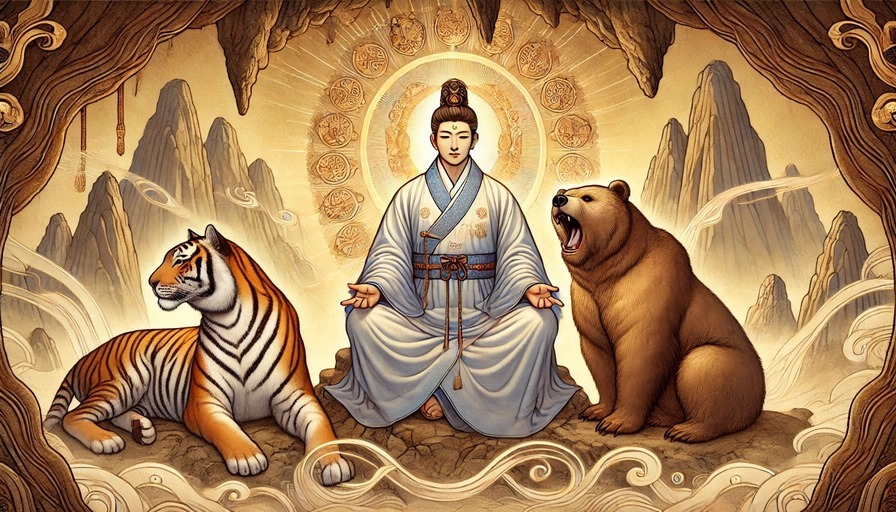
A long, long time ago, the heavenly prince Hwanung (환웅), son of the sky god Hwanin (환인), looked down upon the human world. He saw people struggling and wished to guide them, so he descended from the heavens to Baekdu Mountain (백두산) with 3,000 heavenly followers.
As ruler of the world below, Hwanung governed agriculture, weather, justice, and medicine, teaching humans how to build a proper civilization. 🌱🌧️⚖️
One day, two animals—a bear (곰) and a tiger (호랑이)—came to him with an unusual request:
💬 “We want to become human!”
Hwanung, moved by their determination, agreed—but only under one condition:
🎙️ “Stay in a dark cave for 100 days, eating only garlic 🧄 and mugwort 🌿.”
This was a test of patience, endurance, and willpower. The tiger, unable to bear the hunger and darkness, gave up and ran out of the cave. 🏃💨 The bear, however, endured the challenge with quiet determination. After just 21 days, the bear transformed into a beautiful woman—Ungnyeo (웅녀, ‘Bear Woman’).
Though she had become human, Ungnyeo was lonely. She prayed earnestly at Sindansu (신단수, the divine tree), asking for a child. Moved by her devotion, Hwanung married Ungnyeo, and together, they had a son—👑 Dangun Wanggeom (단군 왕검), the legendary founder of Gojoseon (고조선), the first Korean kingdom. 🏯 This is why many Koreans jokingly say they are descended from a bear! 🐻
The Meaning: A Story of Perseverance & Korean Identity
The Dangun myth isn’t just about the birth of a nation—it also teaches core values deeply embedded in Korean culture:
✔️ Patience (인내심): The bear's ability to endure hardship symbolizes resilience.
✔️ Determination (끈기): Unlike the tiger, the bear persisted and achieved its goal.
✔️ Devotion & Sincerity (정성): Ungnyeo’s sincere prayers were answered, showing the importance of faith and persistence.
These values are still celebrated today in Korean society, where hard work, perseverance, and sincerity are admired traits.
The Celebration: 개천절 (Gaecheonjeol) – Korea’s Foundation Day 🇰🇷
To honor this legend, Koreans celebrate 개천절 (Gaecheonjeol) on October 3rd every year. The name "Gaecheon" (개천) means "the opening of the heavens," symbolizing the birth of the Korean nation. 🎉
While modern historians see this as a myth, it remains a symbol of Korea’s ancient history and cultural identity. The story teaches values like patience, perseverance, and sincerity—traits often admired in Korean society.
From a bear-turned-human to the founder of Korea’s first kingdom, the Dangun myth remains one of the most iconic stories in Korean culture. It’s more than just an origin tale—it’s a story of resilience, patience, and national pride.
If you enjoyed this story, stay tuned for the next one!
See you again next time—bye! 👋😊