Welcome to our new Korean Numbers Series, Part 1!
If Korean numbers have ever felt confusing, this series is for you. We’re going to take you through Korean numbers step by step, from the basics to bigger numbers, counters, money, and more. By the end of the series, you’ll have everything you need to understand and use Korean numbers confidently in everyday life.
But first, there’s one thing that makes Korean numbers a little different. Korean has two number systems: Sino-Korean numbers like 일, 이, 삼, and Native Korean numbers like 하나, 둘, 셋.
Why two? Korean originally had its own native number words. Over many centuries of contact with China, Chinese-derived (Sino) words also became part of the Korean language, including another set of numbers. Instead of replacing the original numbers, Korean kept both. Today, the two systems are simply used in different situations.
That might sound like twice as much to memorize, but don’t worry. You really don’t need to learn two huge number charts all at once. Once you understand a few simple patterns, Korean numbers become much easier. In this first part, we’re going to start with two things you’ll use all the time: dates and time.
[1] Sino-Korean Numbers Follow a Pattern
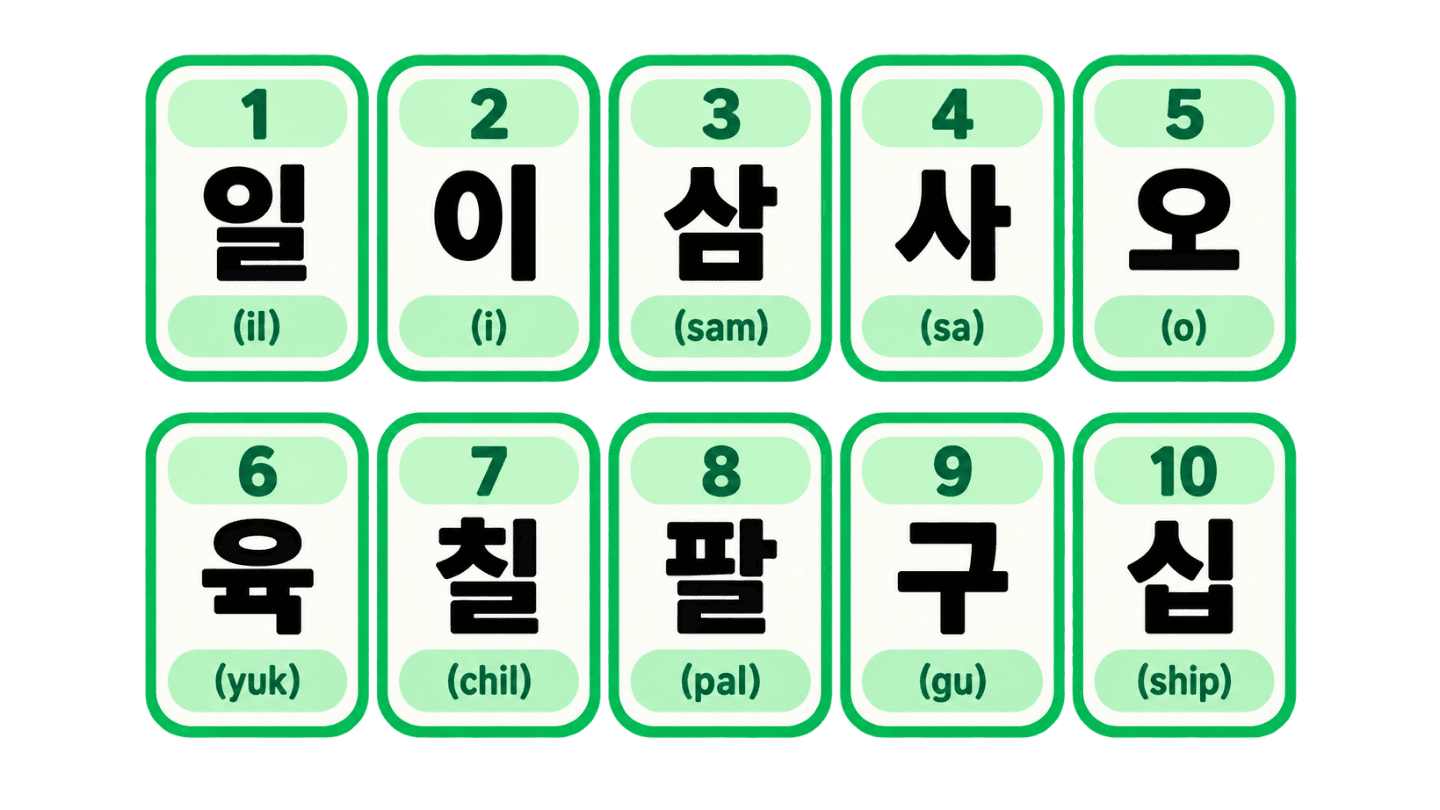
Let's start with Sino-Korean numbers. The first ten are 일, 이, 삼, 사, 오, 육, 칠, 팔, 구, 십. At first, these may just look like ten new words to remember. But once you get to 10, there’s a really helpful pattern.
Think of 십 as “ten.” To make 11, you simply put 1 after 10: 십일. For 12, you put 2 after 10: 십이. The same pattern keeps going all the way to 19.
11 is 십일: 10 + 1
12 is 십이: 10 + 2
13 is 십삼: 10 + 3
Then, when you get to 20, you just put the number of tens in front of 십. So 20 is 이십: literally 2 tens 30 is 삼십: 3 tens, 40 is 사십: 4 tens. And if you want to say a number like 23, you simply put those two ideas together: 23 = 이십삼 (2 tens + 3)
So you don't need a completely new Korean word for every number. Once you know 1 to 10, you can use the same simple pattern to build many bigger numbers yourself.
[2] Saying Dates: ‘월’ and ‘일’
Now that you know how Sino-Korean numbers work, here’s some good news: you can already say almost any date in Korean! The pattern is very simple. For a month, take the Sino-Korean number and add 월 [wol], which means “month.”
1월 is 일월: January
3월 is 삼월: March
5월 is 오월: May
8월 is 팔월: August
12월 is 십이월: December
For the day, we do almost the same thing. Take the Sino-Korean number and add 일 [il], which means “day.”
1일 is 일 일: the 1st
5일 is 오 일: the 5th
14일 is 십사 일: the 14th
25일 is 이십오 일: the 25th
31일 is 삼십일 일: the 31st
Then, just put the month and day together, in that order. For example, 8월 14일 → 팔월 십사 일. That’s August 14th. You already knew 팔 for 8 and 십사 for 14. We just added 월 and 일!
There are only two months that don’t follow the usual pattern. These two are worth remembering, but everything else follows the pattern you just learned.
6월 is 유월, not 육월.
10월 is 시월, not 십월.
Now let’s try a few more dates. See if you can say each one out loud before looking at the Korean.
1월 1일 → 일월 일 일 [i-rwol i-lil]
3월 10일 → 삼월 십 일 [sam-wol si-bil]
6월 25일 → 유월 이십오 일 [yu-wol i-si-bo-il]
9월 24일 → 구월 이십사 일 [gu-wol i-sip-sa-il]
10월 31일 → 시월 삼십일 일 [si-wol sam-si-bil-il]
12월 25일 → 십이월 이십오 일 [si-bi-wol i-si-bo-il]
Take your time with them. You don’t need to say every date perfectly right away. The more you see the same pattern and say it out loud, the easier it gets.
[3] Telling Time
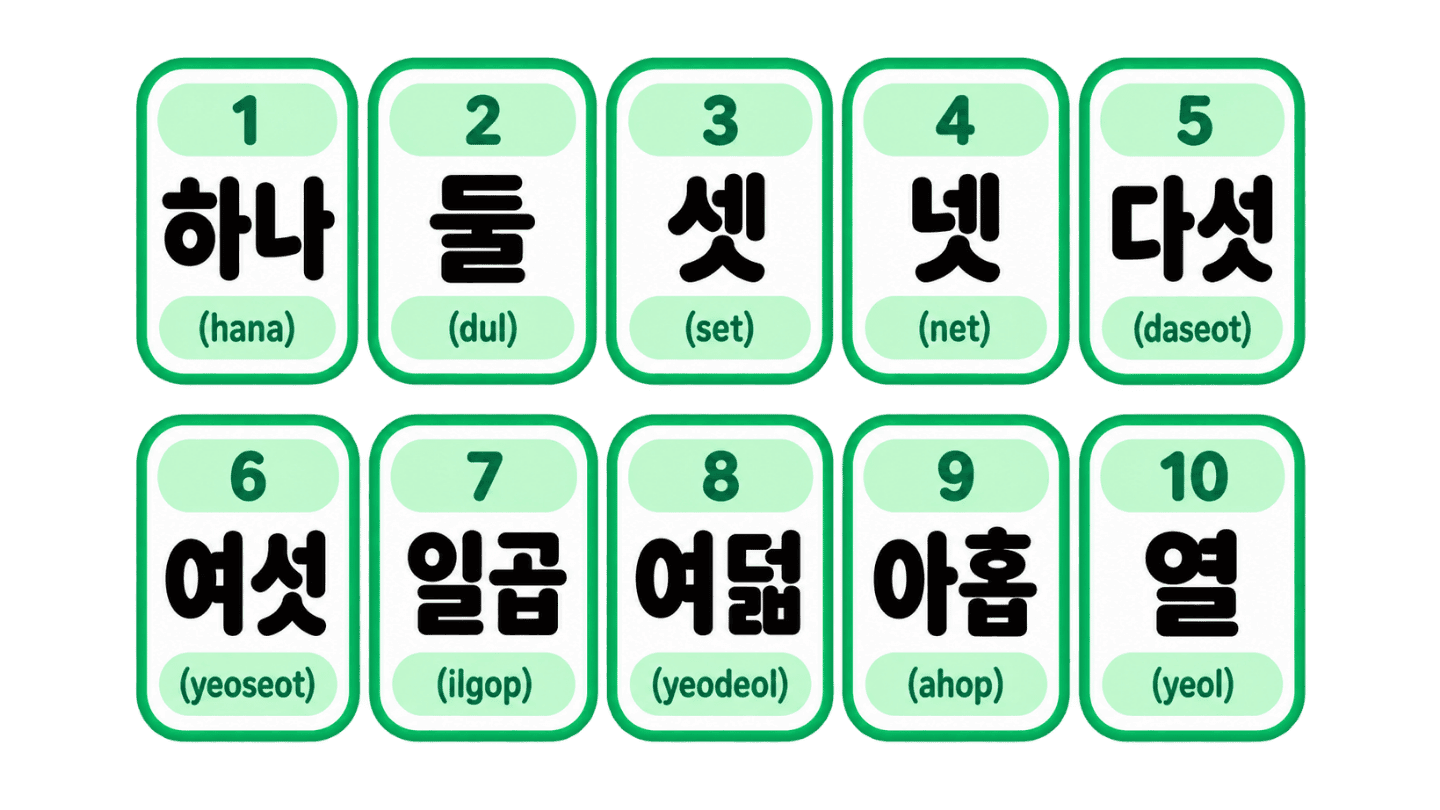
Step 1. Native Korean Numbers for the Hour
Now let's move on to time. This is where we need Native Korean numbers. 하나, 둘, 셋, 넷, 다섯, 여섯... But don't worry. You don't need all of the Native Korean numbers yet. To tell the time, we only need 1 through 12.
For the hour, we use a Native Korean number with 시 [si], which means "o'clock." Here's one small change. 하나 becomes 한, 둘 becomes 두, 셋 becomes 세, and 넷 becomes 네 when they come before 시.
1 o'clock → 한 시
2 o'clock → 두 시
3 o'clock → 세 시
4 o'clock → 네 시
After that, the pattern is very simple. Five o'clock is 다섯 시, seven o'clock is 일곱 시, and ten o'clock is 열 시.
Step 2. Minutes Go Back to Sino-Korean
For minutes, we switch back to the Sino-Korean numbers we learned earlier. This time, we add 분 [bun], which means "minutes."
5 minutes is 오 분.
10 minutes is 십 분.
15 minutes is 십오 분.
30 minutes is 삼십 분.
Remember the pattern we learned earlier? You can use the exact same pattern here.
Step 3. Put the Hour and the Minute Together
Now we have both pieces. Let's put them together. The hour always comes first, and then the minutes.
1:05 is 한 시 오 분 [han si o bun].
3:10 is 세 시 십 분 [se si sip-ppun].
7:30 is 일곱 시 삼십 분 [il-gop ssi sam-sip-ppun].
12:45 is 열두 시 사십오 분 [yeol-du si sa-si-bo-bun].
At first, using one number system for the hour and another one for the minutes can feel a little strange. That's completely normal. You don't have to remember everything perfectly after reading it once. The important thing is to start noticing the pattern and saying the numbers out loud.
[4] Practice Saying Them Out Loud
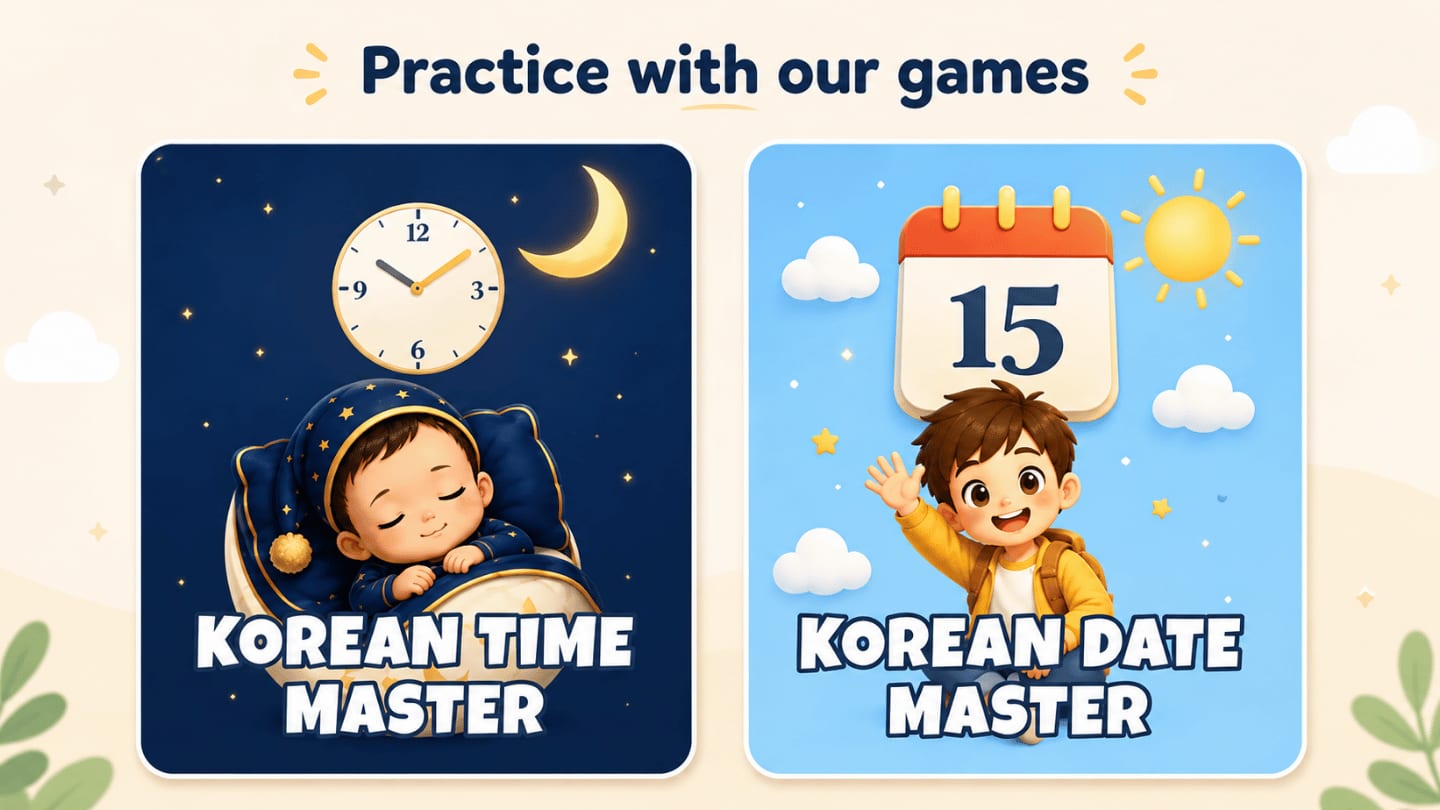
You’ve learned the patterns. Now it’s time to actually say them out loud. Try saying a few dates and times on your own. You might need a second to think, and that’s completely okay. The goal isn’t to answer as fast as possible. Just give yourself a moment, say it, and try again if you need to.
To help you practice, we made two free speaking games. A date or clock will appear on the screen, and you can say the answer out loud and check how it sounds.
You can repeat them as many times as you like. If you forget a number or say something differently, just listen again and give it another try.
Korean numbers can feel like a lot at first, but you don’t need to learn everything in one day. Keep using the small patterns you learned here, and little by little, they’ll start to come out more naturally.
화이팅! 😊