Quick Summary
- 01
Thing + Number + Counter
사과 두 개 = two apples
- 02
Counting uses Native Korean numbers
한, 두, 세, 네 before a counter: 한 개, 두 명, 세 마리
- 03
Ask “how many” with 몇
몇 개예요? 몇 명이에요?
Welcome to our Korean Numbers Series, Part 3!
In English, you can simply say “two apples.” In Korean, you need one more little word: a counter (also called a counter word). Counting in Korean follows one simple pattern: thing + number + counter. So two apples is 사과 두 개. Korean has a lot of counters, but you don’t need them all. Start with 개 for everyday things, 명 for people, and 마리 for animals.
[1] How to Count in Korean: Thing + Number + Counter

Thing: what you want to count, like 키위, 티셔츠, or 사람.
Number: when you count things, use Native Korean numbers. Before a counter, 하나 → 한, 둘 → 두, 셋 → 세, 넷 → 네.
Counter: a small word that shows what kind of thing you’re counting.
Put them together: 사과 (apple) + 두 (two, not 둘) + 개 = 사과 두 개. Not sure which number system to use? Part 2 explains it.
[2] 개: The Korean Counter for Things
개 is the most useful Korean counter. It counts everyday objects, like apples, pens, cookies, and hats, so it’s the first counter to learn. When you don’t know a more specific counter yet, 개 is usually a safe choice.
Put a Native Korean number before 개. Here is 1 to 10:
Number | With 개 | Number | With 개 |
|---|---|---|---|
1 | 한 개 | 6 | 여섯 개 |
2 | 두 개 | 7 | 일곱 개 |
3 | 세 개 | 8 | 여덟 개 |
4 | 네 개 | 9 | 아홉 개 |
5 | 다섯 개 | 10 | 열 개 |
Now add the thing in front. The same 개 works for all of these:
도넛 한 개 (one donut)
펜 두 개 (two pens)
모자 세 개 (three hats)
쿠키 네 개 (four cookies)
사과 다섯 개 (five apples)
To ask how many, use 몇 개: 사과 몇 개예요? (How many apples?) There’s more on 몇 below.
When not to use 개
개 covers most objects, but people and animals have their own counters, and drinks usually use their container:
People → 명: 사람 두 명, not 사람 두 개
Animals → 마리: 강아지 한 마리
Drinks → 병 (bottle) or 잔 (cup): 커피 한 잔
[3] Korean Counters for People and Animals: 명 and 마리
Before you use 개 for everything: people and animals usually get their own counters. Using them makes you sound much more natural.
For people, use 명. 사람 means “person.”
사람 한 명 / 사람 두 명 / 사람 세 명 / 사람 네 명 / 사람 다섯 명
For animals, use 마리. 강아지 means “puppy” or “dog.”
강아지 한 마리 / 강아지 두 마리 / 강아지 세 마리 / 강아지 네 마리 / 강아지 다섯 마리
[4] Korean Counters List: The 7 You’ll Use Most
Counter | Used for | Example |
|---|---|---|
개 | Everyday things | 사과 두 개 (2 apples) |
명 | People | 사람 세 명 (3 people) |
마리 | Animals | 강아지 한 마리 (1 dog) |
병 | Bottles | 콜라 한 병 (1 bottle of cola) |
잔 | Cups, glasses | 커피 한 잔 (1 cup of coffee) |
권 | Books | 책 두 권 (2 books) |
장 | Flat things: paper, tickets, photos | 티켓 한 장 (1 ticket) |
With drinks, the container decides the counter. A bottle is 병 and a cup or glass is 잔, so the same drink can change: 주스 세 병 (three bottles of juice), 주스 두 잔 (two glasses of juice).
[5] How to Ask “How Many?” in Korean: 몇
몇 means “how many.” Put it right before the counter, and answer with a number in the same spot.
사과 몇 개예요? 사과 한 개예요. (How many apples? One apple.)
사람 몇 명이에요? 사람 네 명이에요. (How many people? Four people.)
강아지 몇 마리예요? 강아지 다섯 마리예요. (How many dogs? Five dogs.)
책 몇 권이에요? 책 여섯 권이에요. (How many books? Six books.)
개 and 마리 end in a vowel, so they take 예요. 명 and 권 end in a consonant, so they take 이에요.
[6] Sino-Korean Numbers with Units: 층, 도, 인분
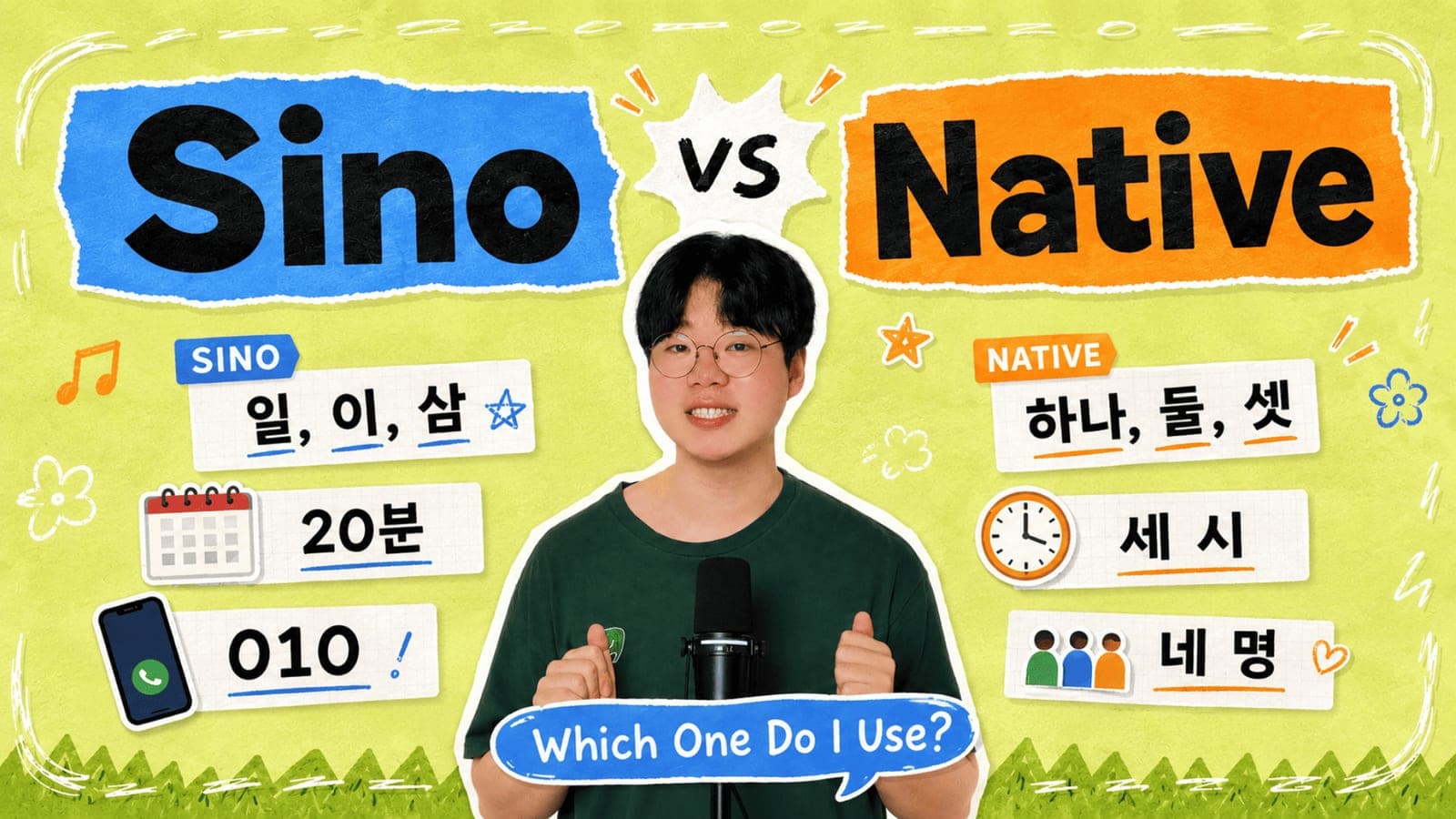
Floors, temperature, length, servings, school years, and pages work a little differently. (Dates and time are covered in Part 1.) You’re not counting things one by one. You’re labeling or measuring, so you use Sino-Korean numbers (일, 이, 삼). The pattern stays the same: thing + number + unit.
Unit | Meaning | Example |
|---|---|---|
층 | Floor | 삼 층 (3rd floor) |
도 | Degrees (°C or °F) | 섭씨 이십 도 (20°C), 화씨 칠십 도 (70°F) |
미터 | Meters | 이 미터 (2 m) |
피트 | Feet | 오 피트 (5 ft) |
인분 | Servings (of food) | 이 인분 (2 servings) |
학년 | School year, grade | 삼 학년 (3rd grade) |
쪽 | Page | 십오 쪽 (page 15) |
And 몇 works here too:
몇 층이에요? 삼 층이에요. (Which floor? The 3rd floor.)
몇 도예요? 이십 도예요. (What’s the temperature? 20 degrees.)
몇 피트예요? 오 피트예요. (How many feet? 5 feet.)
몇 학년이에요? 삼 학년이에요. (What grade are you in? 3rd grade.)
[7] More Korean Counters You’ll Hear
Korean has many more counter words. You don’t need these to start speaking, but you’ll hear them often.
Counter | Used for | Example |
|---|---|---|
벌 | Clothes | 옷 두 벌 (2 outfits) |
켤레 | Pairs of shoes, socks | 신발 두 켤레 (2 pairs of shoes) |
송이 | Flowers | 꽃 세 송이 (3 flowers) |
줄 | Rolls of kimbap | 김밥 두 줄 (2 rolls of kimbap) |
조각 | Pieces, slices | 피자 두 조각 (2 slices of pizza) |
봉지 | Bags, packets | 과자 세 봉지 (3 bags of chips) |
Don’t let the long list stop you. For many everyday objects, 개 will get you pretty far. When you meet a new counter, just add it to what you already know, one at a time.
[8] Three Common Mistakes with Korean Counters
These are the mix-ups we hear most from learners. Cover the Right column and see if you can fix each one yourself.
Wrong | Right | Why |
|---|---|---|
사람 두 개 | 사람 두 명 | People are counted with 명, not 개. |
둘 개 | 두 개 | 하나, 둘, 셋, 넷 get shorter before a counter: 한, 두, 세, 네. |
세 층 (3rd floor) | 삼 층 | To say which floor, use Sino-Korean numbers. 세 층 means three floors. |
[9] Practice: Korean Counters Game
The best way to get used to counters is to use them. In our free game, you answer “how many” questions with 몇:
Choose the right counter for the question.
Choose the right number for the answer.
Choose the counter again to finish the full answer.
If you make a mistake, just try again. That’s what practice is for. Coming next in Part 4: bigger Korean numbers and Korean money. Want a head start? Try the Korean price game.
Korean Counters: FAQ
Counters are small words that come after a number to show what you’re counting, like 개 for things, 명 for people, and 마리 for animals: 사과 두 개 (two apples).
개. It works for many everyday objects, so it’s the best counter to learn first.
A lot. But seven cover most everyday counting: 개, 명, 마리, 병, 잔, 권, 장.
When you count things, people, or animals, use Native Korean numbers: 사과 두 개. For floors, temperature, and measurements, use Sino-Korean numbers: 삼 층, 이십 도.
Use 몇 + counter: 몇 개예요? 몇 명이에요? 몇 마리예요?